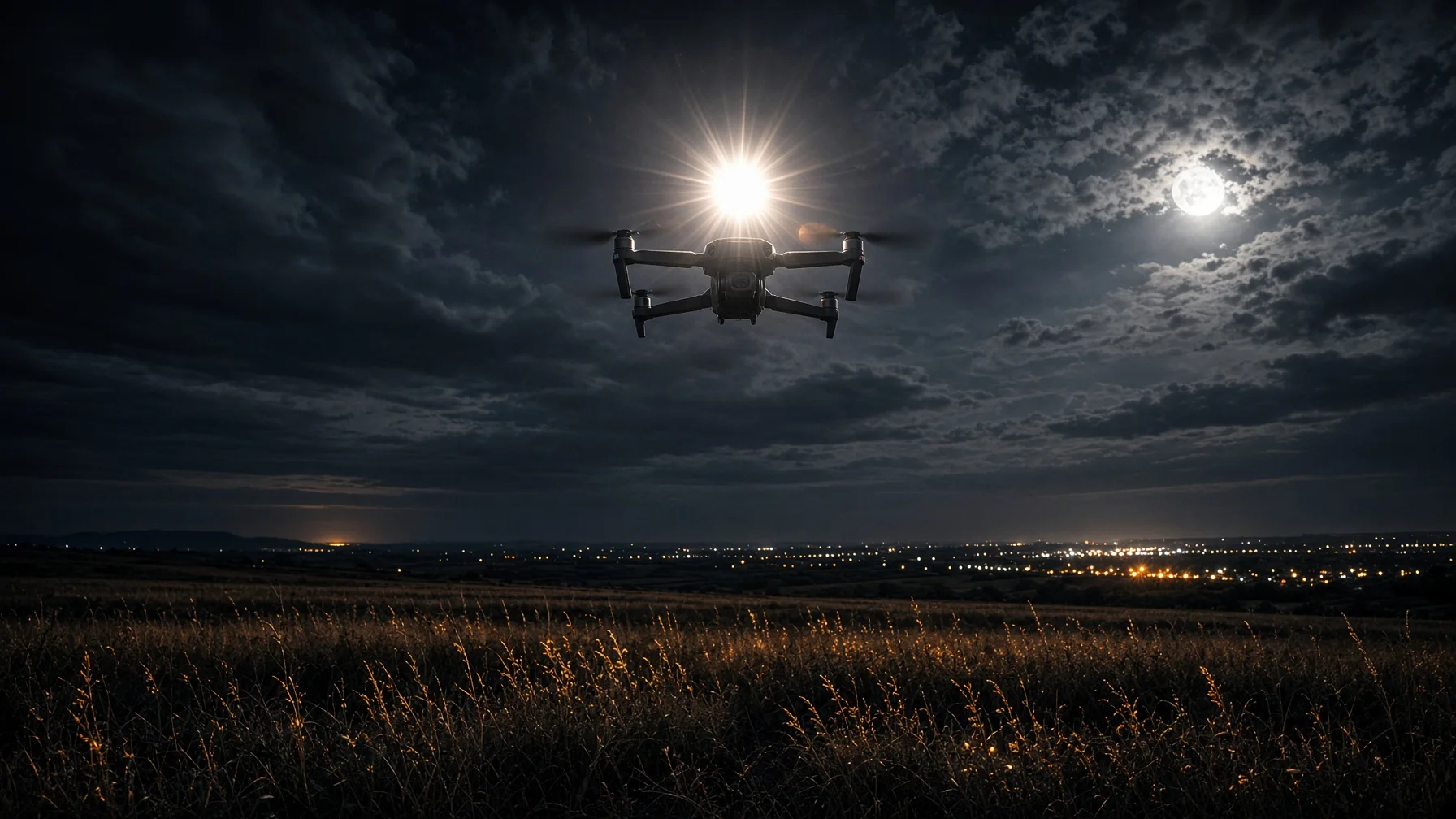
Alabama looks different after dark. Downtown skylines light up, football fields glow, boats move across black water, and summer heat finally begins to ease. It is easy to see why drone pilots want to fly at night.
Night flying is legal in many situations, but it is not simply daytime flying with the sun turned off. The aircraft becomes harder to judge, obstacles disappear into the background, visual line of sight gets more demanding, and a location that looked open during the day may sit inside controlled airspace or near a temporary restriction.
The first question is not whether your drone can physically fly after sunset. It is which set of rules applies to your purpose, what lighting and training those rules require, and whether the location is legal at that time.
Is It Legal to Fly a Drone at Night in Alabama?
Generally, yes. The FAA allows night operations under both Part 107 and the recreational exception when the pilot meets the applicable requirements. Federal aviation rules control the use of the national airspace, while state and local rules may still affect where you may launch, land, possess equipment, or conduct certain activities.
That distinction matters. A map may show that the airspace is available while the property owner, park authority, event organizer, or state agency does not allow you to operate from the ground location. Permission to use a launch site and authorization to use controlled airspace are separate issues.
Before every night flight, determine whether the operation is recreational or falls under Part 107. A flight does not become recreational merely because nobody handed you cash. If the purpose supports a business, client, organization, property listing, event, inspection, promotional project, or another non-recreational objective, Part 107 is normally the applicable path.
Part 107 Night-Flight Requirements
FAA-certificated remote pilots may conduct routine night operations without a night waiver when they satisfy the current Part 107 requirements. The remote pilot must have completed the applicable updated initial knowledge test or recurrent training, and the drone must have anti-collision lighting visible for at least three statute miles with a flash rate sufficient to help avoid a collision.
The light requirement is about conspicuity, not merely orientation. The built-in red and green arm lights on many consumer drones may help the pilot understand the aircraft's direction, but they do not automatically satisfy the three-statute-mile anti-collision requirement. Pilots should verify the specifications of the light they plan to use and mount it without blocking GPS reception, cooling vents, sensors, or propellers.
The FAA also requires the remote pilot to maintain visual line of sight. At night, that means being able to determine the aircraft's location, altitude, attitude, and direction of flight well enough to control it and avoid hazards. A bright strobe can make the drone visible from farther away, but seeing a blinking point does not always mean the pilot can accurately judge everything the rule requires. Shorter operating distances are often the practical answer.
Part 107 pilots must also observe operating visibility and cloud-clearance rules. Darkness, haze, smoke, fog, humid summer air, and low clouds can reduce what looks like a simple flight into an unsafe operation. A clear view of the drone does not eliminate the duty to watch the surrounding airspace for helicopters, medical flights, agricultural aircraft, and other low-flying traffic.
Recreational Night Flying
Recreational pilots may also fly at night, but they must follow the safety guidelines of an FAA-recognized community-based organization. The FAA specifically notes that recreational flyers operating at night must use CBO safety guidelines that include night procedures and lighting requirements.
Recreational flyers must still complete TRUST and carry proof of passage, register drones that require registration, comply with Remote ID when applicable, maintain visual line of sight, give way to all other aircraft, and stay within the authorized altitude for the airspace.
A common mistake is assuming that a sub-250-gram drone removes every obligation. A light drone may avoid registration in a purely recreational operation, but the pilot still has airspace, safety, visual-line-of-sight, and CBO-guideline responsibilities. Once the aircraft is used under Part 107, registration requirements generally apply regardless of its weight.
Controlled Airspace Does Not Turn Off at Sunset
Night does not create a free pass around an airport. If the launch area is inside controlled airspace, the pilot still needs FAA authorization. LAANC may provide near-real-time authorization at eligible locations and altitudes, while operations requiring further coordination may take longer.
This is especially important around Birmingham, Huntsville, Montgomery, Mobile, Tuscaloosa, Auburn, Dothan, and the many smaller Alabama airports and heliports. A dark field can look isolated while still sitting inside controlled airspace or close to an active medical-helicopter route.
Use an FAA-approved B4UFLY service or another current FAA-connected planning tool before traveling to the site. Check the exact location rather than relying on memory from a previous flight. Airspace conditions, temporary flight restrictions, special events, emergency activity, and authorization status can change.
Temporary Flight Restrictions and Emergency Activity
Alabama night operations often happen around football games, concerts, storms, wildfires, law-enforcement activity, and community events. Those are also situations in which temporary restrictions or low-flying public-safety aircraft may be present.
Never interfere with emergency responders. If helicopters, fire crews, law enforcement, or other emergency aircraft are operating nearby, land immediately and give them the area. A drone pilot may not see or hear a helicopter early enough at night to make a last-second decision safely.
Large sporting events can also trigger federal stadium flight restrictions under specific conditions. Not every local field falls under that rule, but event organizers and property managers may impose their own restrictions. Verify both the airspace and ground permission rather than assuming that a public event means public permission to fly.
The Alabama Ground-Location Problem
A legal flight path does not automatically create a legal launch point. Alabama agencies can restrict drone launch, landing, possession, or use on property they manage. For example, current Alabama administrative rules require written permission for drone use on certain State Lands Division properties and on specified wildlife-management or Forever Wild areas.
The practical rule is simple: identify who controls the ground before you unpack. For state-managed land, read the current agency rule and contact the responsible office when permission is required. For city parks, sports complexes, private venues, marinas, neighborhoods, and commercial property, obtain permission from the owner or manager. Avoid setting up where people could reasonably think they are being secretly recorded.
Night Flight Requires a Better Site Survey
A good daylight inspection is one of the strongest night-safety tools. Visit the location before dark when possible and identify:
- Power lines and thin utility wires
- Guy wires, poles, antennas, cranes, and towers
- Trees extending above the planned flight path
- Flagpoles and light poles around fields or parking lots
- Reflective surfaces and water that may confuse visual judgment
- Roads, moving vehicles, pedestrians, and gathering areas
- Safe emergency landing zones
- Sources of bright glare that can affect the pilot's vision
Save a mental or written maximum altitude below the legal ceiling when obstacles make the full altitude unnecessary. Night is not the time to discover a nearly invisible wire by flying toward it.
Prepare the Aircraft for Darkness
Start with a fully charged aircraft, controller, phone or display, and anti-collision light. Confirm the light's attachment before powering up. Loose hook-and-loop straps, adhesive pads, and clip mounts deserve extra attention because a detached strobe can hit a propeller or fall onto property below.
Set return-to-home altitude with known obstacles in mind, but do not treat automated return-to-home as a replacement for active piloting. Confirm the home point, compass status, satellite connection, battery temperature, and Remote ID status when required. Keep the launch area illuminated enough to inspect the aircraft without destroying your night vision.
Screen brightness should be low enough that the pilot can still see the surrounding sky. A bright controller display can make a person temporarily blind to dim objects after looking up. Some pilots use a small shield or position the screen to reduce glare.
Weather Matters More Than It Looks
Alabama humidity can create haze that scatters city lights and makes distance difficult to judge. Ground-level conditions may look calm while winds above trees or buildings are significantly stronger. Summer thunderstorms can develop rapidly, and distant lightning is a reason to stop rather than an opportunity for dramatic footage.
Check current radar, wind, visibility, cloud ceilings, temperature, and dew point before launch. Watch for fog formation near lakes, rivers, fields, and low areas. If moisture begins collecting on the aircraft or the horizon disappears into haze, bring the drone back.
Keep the Mission Simple
The best first night flight is not a long cinematic route. Use a small, familiar area and a short plan. Establish orientation, climb slowly, verify the view, capture the intended shots, and return with a generous battery reserve.
Avoid flying backward or sideways for long distances unless the entire path has been surveyed and remains visible. Obstacle-avoidance systems may perform differently in low light, and some sensors may be unavailable. Read the aircraft manual rather than assuming automated detection will protect the drone.
A visual observer can be valuable even when not legally required. The observer should stand next to the pilot, understand the flight plan, watch for aircraft and people, and communicate clearly. The observer should not be distracted by filming the drone or looking at a second screen.
A Practical Alabama Night-Flight Checklist
Before launch:
- Confirm whether the flight is recreational or Part 107.
- Verify pilot training, TRUST, certification, registration, and Remote ID requirements.
- Check controlled airspace and obtain LAANC or DroneZone authorization when required.
- Check current TFRs and nearby airport or heliport activity.
- Confirm permission to use the launch and landing site.
- Inspect the location during daylight when practical.
- Install and test the required lighting.
- Check weather, visibility, clouds, wind, and thunderstorm activity.
- Set a conservative flight boundary and return-to-home altitude.
- Brief any visual observer and identify emergency landing areas.
During flight:
- Maintain visual line of sight.
- Keep the aircraft close enough to judge orientation and movement.
- Yield immediately to manned aircraft.
- Stay away from people, moving vehicles, emergency operations, and private activity unrelated to the mission.
- Return before the battery reaches a stressful level.
- Stop if visibility, weather, lighting, or situational awareness deteriorates.
The Bottom Line
Night drone flying in Alabama can be legal, useful, and visually impressive. It also demands more discipline than a routine daytime launch. The legal foundation is straightforward: know which operating rules apply, use the required lighting, maintain visual line of sight, obtain controlled-airspace authorization when needed, and respect restrictions on the property below.
The practical foundation is just as important. Survey the site, stay closer than usual, expect reduced sensor performance, monitor Alabama weather, and keep the mission simple. Darkness rewards preparation and punishes improvisation.
FAQs
Can I fly my drone at night in Alabama without a Part 107 certificate?
Yes, when the flight is genuinely recreational and you comply with the recreational rules, including TRUST, applicable registration and Remote ID requirements, visual line of sight, airspace authorization, and an FAA-recognized CBO's night-safety and lighting guidelines. A business-related or non-recreational purpose normally falls under Part 107.
Do the lights already built into my drone satisfy Part 107 night requirements?
Not necessarily. Part 107 night operations require anti-collision lighting visible for at least three statute miles with a sufficient flash rate. Built-in navigation or status lights may not meet that standard. Verify the manufacturer's specifications or use a purpose-built compliant light.
Do I need LAANC authorization to fly at night?
You need authorization when operating in controlled airspace, whether it is day or night. LAANC may provide authorization in eligible areas. Flying in uncontrolled Class G airspace does not require LAANC, but all other applicable rules still apply.
Can I launch a drone from an Alabama state park or public wildlife area at night?
Do not assume that public ownership permits drone operations. Alabama agencies restrict drone launch, landing, possession, or use on some state-managed lands and wildlife areas unless written permission is obtained. Check the exact property's current rule and contact the managing agency before the flight.
Is a visual observer required for every night flight?
Not automatically, but the pilot must maintain the visual awareness required by the applicable rule. A co-located visual observer can improve safety by watching for aircraft, people, vehicles, and obstacles while the pilot manages the aircraft.
Source Notes
Federal Aviation Administration — Getting Started / Flying at Night:
https://www.faa.gov/uas/getting_started
Federal Aviation Administration — Recreational Flyers and Community-Based Organizations:
https://www.faa.gov/uas/recreational_flyers
Federal Aviation Administration — Recreational Airspace Authorizations:
https://www.faa.gov/uas/recreational_flyers/authorization
Federal Aviation Administration — Part 107 Airspace Authorizations:
https://www.faa.gov/uas/commercial_operators/part_107_airspace_authorizations
Federal Aviation Administration — B4UFLY:
https://www.faa.gov/uas/getting_started/b4ufly
Federal Aviation Administration — Aeronautical Information Manual, UAS Night Operations:
https://www.faa.gov/air_traffic/publications/atpubs/aim_html/chap11_section_8.html
Alabama Legislative Services Agency — Alabama Administrative Code Rule 220-4-.15:
https://admincode.legislature.state.al.us/administrative-code/220-4-.15
Alabama Legislative Services Agency — Alabama Administrative Code Rule 220-2-.125:
https://admincode.legislature.state.al.us/administrative-code/220-2-.125