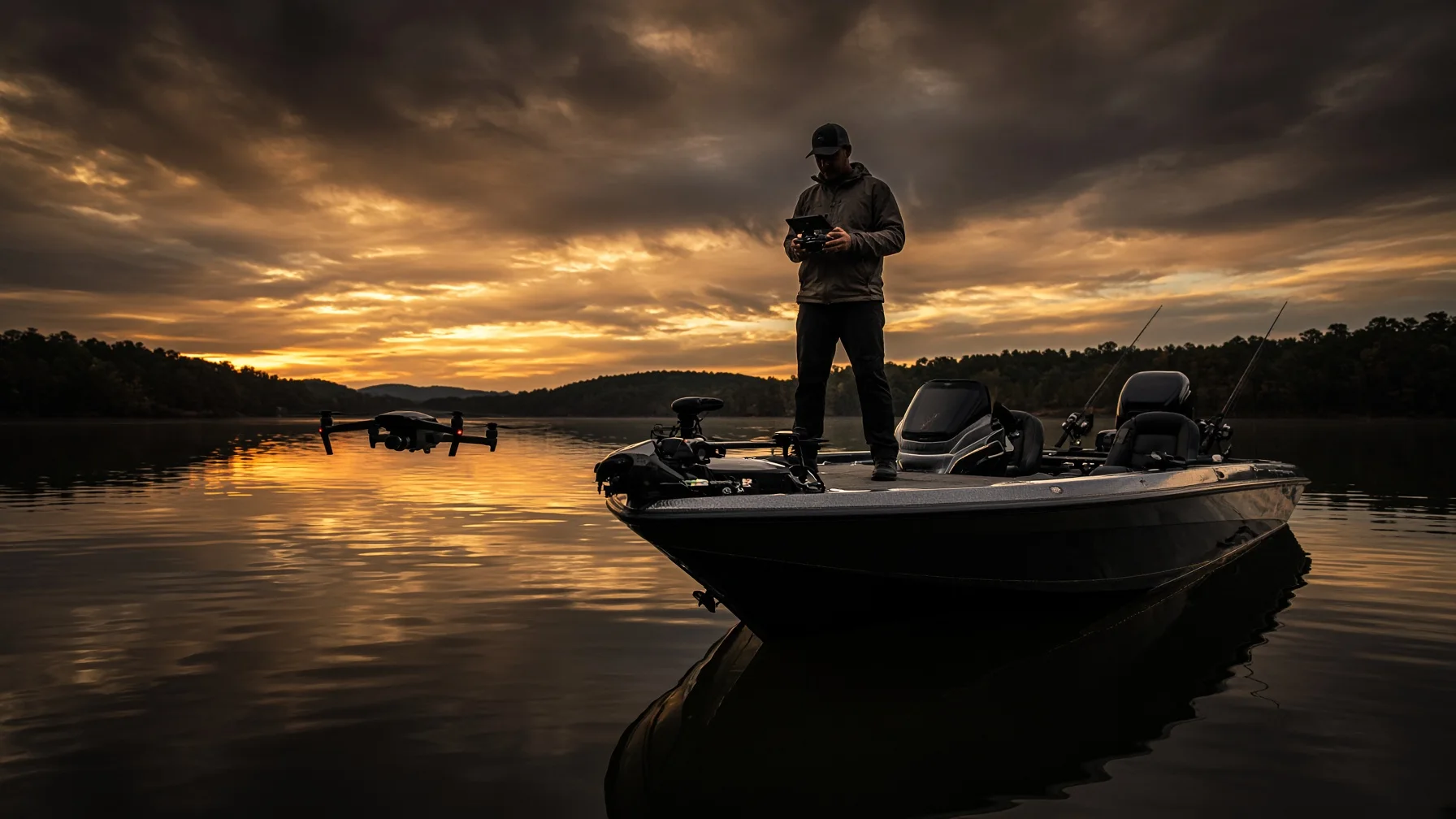
Alabama has plenty of water worth filming: broad reservoirs, narrow river channels, marinas, bass boats at first light, wake boats in open water, and long shoreline runs that look completely different from the air. The mistake is assuming that a drone flight from a boat works exactly like a flight from dry land.
It does not.
The aircraft rules still come from the FAA, but the boat creates extra problems that a normal launch site does not: a moving control station, changing return-to-home geometry, a small landing area, prop wash near passengers, glare on the screen, waves underfoot, and the possibility that the boat operator is also trying to watch the aircraft. On Alabama water, boating rules and basic seamanship matter at the same time.
This guide is not a substitute for checking current airspace, local access rules, and the exact FAA operating rule that applies to your flight. It is a practical breakdown of the issues that matter most before you launch.
First question: is the flight recreational or non-recreational?
The purpose of the flight determines the FAA rule set.
A purely recreational flight may qualify under the statutory exception for limited recreational operations. The FAA says recreational pilots must fly only for personal enjoyment, follow an FAA-recognized community-based organization’s safety guidelines, keep the drone within visual line of sight, yield to other aircraft, obtain authorization before flying in controlled airspace, stay at or below 400 feet in uncontrolled airspace, pass TRUST, carry proof of completion, and meet registration and Remote ID requirements when applicable.
A flight is not automatically recreational just because nobody pays cash at the boat ramp. Footage created for a business, sponsor, client, monetized channel, marina, fishing guide, tournament organizer, property owner, or other non-recreational purpose generally falls under Part 107 unless another operating authority applies.
Under Part 107, the pilot must hold a Remote Pilot Certificate and comply with the operating rules for small unmanned aircraft.
Can you legally fly from a moving boat?
This is where many pilots oversimplify the answer.
The FAA’s Part 107 summary states that a pilot may not operate a drone from a moving vehicle unless the operation is over a sparsely populated area and does not involve transporting property for compensation or hire. The FAA’s waiver guidance also identifies operation from a moving vehicle in populated areas as an operation that requires relief from Section 107.25.
A boat can be a moving vehicle for this purpose. That means a Part 107 pilot should not assume that slow speed, open water, or a quiet cove automatically makes any moving-boat operation compliant. The surrounding population, shoreline, nearby vessels, purpose of the operation, and exact flight plan matter.
For many practical shoots, the cleaner plan is simple: stop the boat, establish a stable control position, launch while stationary, and recover while stationary. Anchoring may be appropriate in some locations, but only when it is safe and lawful to do so and does not place the vessel in a navigation channel, near a dam, or in conflict with local restrictions.
Recreational pilots still must comply with the recreational rules, maintain visual line of sight, avoid careless or dangerous operation, and check current airspace restrictions. Even when a specific Part 107 moving-vehicle provision is not the controlling rule for a recreational flight, launching from a moving boat can create the same safety problems.
Visual line of sight gets harder on the water
The FAA requires the remote pilot or a properly used visual observer to maintain visual line of sight under the applicable rules. Water can make that harder than expected.
Common problems include:
- Bright glare that makes a small aircraft disappear against the sky or reflective water
- A boat turning while the drone continues on its original heading
- Long, featureless sight lines that make distance difficult to judge
- Trees, bluffs, bridges, docks, or bends in a river blocking the aircraft
- The aircraft blending into a dark shoreline
- Attention being split between the screen, the aircraft, boat traffic, and passengers
A visual observer can be useful, but that person needs a clear role and direct communication with the pilot. The observer should not also be responsible for driving the boat through traffic, watching a skier, handling fishing lines, or managing several unrelated tasks.
Your return-to-home point may be behind you
On land, pilots often launch, fly, and land near the same fixed point. On a boat, the control station may drift or travel away from the recorded home point.
That matters if the aircraft triggers return-to-home because of a lost link, low battery, pilot command, or another automated event. Depending on the aircraft and settings, it may fly toward the original launch point rather than the boat’s current position. The result can be a drone hovering over empty water while the boat is hundreds of yards away.
Before launch, know how the exact aircraft handles:
- Home-point recording
- Dynamic or controller-based home-point updates, if supported
- Loss-of-signal behavior
- Low-battery return behavior
- Landing protection over water
- Obstacle sensing over reflective surfaces
- Manual cancellation of return-to-home
Do not assume every drone behaves the same way. Manufacturer documentation should control setup decisions for the specific model.
A practical approach is to keep the operating area close, maintain battery margin, avoid long downwind runs, and position the boat so the drone can return without crossing crowds, docks, or active lanes.
Hand launch and hand catch are not beginner moves
A small boat may have no clean deck area. Antennas, rods, coolers, bimini tops, rails, passengers, and moving lines can all interfere with a launch or landing.
Hand launching and hand catching may look convenient, but they place spinning propellers close to faces and hands. A wave, wake, sudden throttle input, unstable GPS position, or unexpected aircraft movement can turn a routine recovery into an injury.
A safer plan is usually to create a clear, dry launch zone while the vessel is stationary. Remove loose items, keep passengers away, secure fishing line, and make sure the boat operator understands that sudden movement can ruin the recovery.
Where a hand recovery is genuinely necessary, it should only be attempted by someone familiar with that aircraft and procedure. It should never be improvised around children, distracted passengers, or rough water.
Water creates equipment problems too
A drone does not need to fall into the lake to be damaged. Spray, mist, wet hands, condensation, and a damp landing surface can be enough to create trouble.
Useful precautions include:
- Keep spare batteries in a dry case
- Use a screen hood when glare is severe
- Carry a clean microfiber cloth for the lens and display
- Keep the controller secured with a strap where appropriate
- Avoid launching through spray or directly beside an idling exhaust outlet
- Inspect propellers after transport in crowded boat storage
- Let wet equipment dry before charging
- Keep fishing line and hooks well away from the launch area
Do not treat an ordinary camera drone as waterproof unless the manufacturer specifically says it is designed for that use.
Check airspace before leaving the dock
Open water is not automatically open airspace.
Alabama lakes and rivers can be near airports, heliports, military areas, stadium restrictions, power facilities, dams, wildlife areas, and temporary flight restrictions. Controlled airspace may require FAA authorization through LAANC or DroneZone. Temporary restrictions can change quickly.
Use an FAA-supported airspace-awareness source before the flight and check again close to launch time. A route that begins in uncontrolled airspace may approach controlled airspace as the boat travels.
Also separate airspace permission from land or facility permission. The FAA controls the national airspace, but a marina, park, launch ramp, dam operator, wildlife area, private dock owner, or event organizer may control access, takeoff, landing, or activities on the property they manage.
Remote ID and registration still apply on the lake
The FAA says drones that are required to be registered, or that are registered, generally must comply with Remote ID. Compliance can come through a Standard Remote ID drone, an attached broadcast module, or operation inside an FAA-Recognized Identification Area under the applicable restrictions.
The FAA also states that recreational drones weighing 0.55 pounds or less may avoid registration when flown under the recreational exception, while other drones generally must be registered. A drone registered for recreational use cannot simply be used under Part 107 without the proper registration category.
The water does not create an exemption. Confirm registration and Remote ID status before the boat leaves the ramp, not after the aircraft reports an error offshore.
Alabama boating safety remains part of the operation
Drone pilots sometimes become so focused on aviation rules that they forget the vessel itself is operating under Alabama boating law.
ALEA requires proper boating conduct and a proper lookout. Its boating guidance prohibits careless or reckless operation and includes rules on vessel registration, operator licensing, required equipment, personal flotation devices, navigation lights, speed zones, wakes, and operation near dams.
ALEA states that every person aboard must have an appropriate life jacket available, children under eight must wear one except in an enclosed cabin, and everyone on a personal watercraft must wear one. Additional requirements apply within 800 feet below a hydroelectric dam or navigational lock and dam.
The drone pilot should not distract the boat operator from maintaining a proper lookout. The best setup uses separate people for separate jobs: one person operates the vessel, one person acts as remote pilot, and—when useful—another person serves as visual observer.
A practical preflight plan for Alabama lakes
Before launch, work through this sequence:
1. Define the purpose
Decide whether the flight is truly recreational or falls under Part 107.
2. Check airspace and restrictions
Review controlled airspace, TFRs, nearby airports, and facility or property restrictions.
3. Choose a stationary launch and recovery point
Stop the vessel in a safe location outside active traffic and hazardous areas.
4. Assign roles
Identify the boat operator, remote pilot, and visual observer. Do not overload one person with all three responsibilities in a busy area.
5. Review home-point and failsafe settings
Know exactly where the aircraft will go if it loses signal or triggers return-to-home.
6. Protect the launch area
Secure rods, hooks, loose clothing, towels, hats, and other objects that can contact the propellers.
7. Set conservative limits
Use a shorter route and larger battery reserve than you might use on land.
8. Plan the recovery before takeoff
Know whether the drone will land on a clear deck, platform, shore location, or another safe surface.
9. Watch weather and boat traffic
Wind over open water can be stronger than it felt at the ramp. Wakes and sudden traffic can destabilize the vessel during recovery.
10. Be willing to cancel
If the deck is crowded, the wind rises, the aircraft cannot maintain a reliable position, or the boat operator needs full attention, land or do not launch.
When shore launch is the better option
Launching from shore often produces the same useful footage with fewer variables. It keeps the home point fixed, gives the pilot a larger landing zone, reduces water exposure, and makes visual orientation easier.
A shore launch may be the better choice when:
- The boat will travel near marinas or populated shoreline
- The pilot is new to over-water operations
- The vessel has no clear launch area
- Wind or wake conditions are unstable
- The planned flight can be completed from public or permitted private access
- The footage requires repeated battery changes
The best drone shot is not necessarily the one taken from the most complicated launch point.
Final takeaway
Flying a drone from a boat on an Alabama lake can be legal and useful, but the boat changes the operation. The pilot must account for the applicable FAA rule set, moving-vessel restrictions, visual line of sight, Remote ID, airspace authorization, changing home-point geometry, launch and recovery risk, and Alabama boating-safety obligations.
The most reliable plan is usually the least dramatic one: verify the rules, stop the boat, separate the pilot and boat-operator roles, keep the aircraft close, preserve battery margin, and recover before conditions become difficult.
Frequently Asked Questions
Can I launch a drone from a boat on an Alabama lake?
Potentially, yes, but the flight must comply with the applicable FAA rules, current airspace restrictions, and any access or facility rules governing the launch location. A moving-boat operation can raise additional issues, especially under Part 107.
Can I fly while the boat is moving?
Under Part 107, the FAA restricts operation from a moving vehicle unless the flight is over a sparsely populated area and does not involve transporting property for compensation or hire. A moving boat can fall within that rule. Stopping the vessel for launch, operation, and recovery is often the simpler approach.
Do I need a Part 107 certificate to film my fishing trip?
A flight conducted only for personal enjoyment may qualify as recreational. Footage created for a guide service, sponsor, client, business, monetized promotion, or another non-recreational purpose generally requires Part 107 operating authority.
Does return-to-home follow my boat?
Not necessarily. Many aircraft record the home point at takeoff and may return to that fixed location unless the system supports and correctly uses another update method. Check the manufacturer’s documentation and settings before launch.
Is a drone under 250 grams exempt from every rule?
No. A sub-250-gram drone flown recreationally may not require registration, but the pilot still must follow the recreational operating rules, airspace restrictions, and safety requirements. Different requirements apply when the same aircraft is used under Part 107.
SOURCE NOTES
FAA — Recreational Flyers & Community-Based Organizations
https://www.faa.gov/uas/recreational_flyersFAA — Small Unmanned Aircraft Systems Regulations (Part 107), updated July 6, 2026
https://www.faa.gov/newsroom/small-unmanned-aircraft-systems-uas-regulations-part-107FAA — Part 107 Waivers
https://www.faa.gov/uas/commercial_operators/part_107_waiversFAA — Remote Identification of Drones
https://www.faa.gov/uas/getting_started/remote_idFAA — How to Register Your Drone
https://www.faa.gov/uas/getting_started/register_droneAlabama Law Enforcement Agency — Boating Rules and Regulations
https://www.alea.gov/resources/laws/boating-rules-and-regulationsAlabama Law Enforcement Agency — Safe Boating
https://www.alea.gov/dps/marine-patrol/safe-boatingAlabama Law Enforcement Agency — Boat Equipment Checklist for Alabama
https://www.alea.gov/dps/marine-patrol/boat-equipment-checklist-alabamaOutdoor Alabama — Boating
https://www.outdooralabama.com/boating