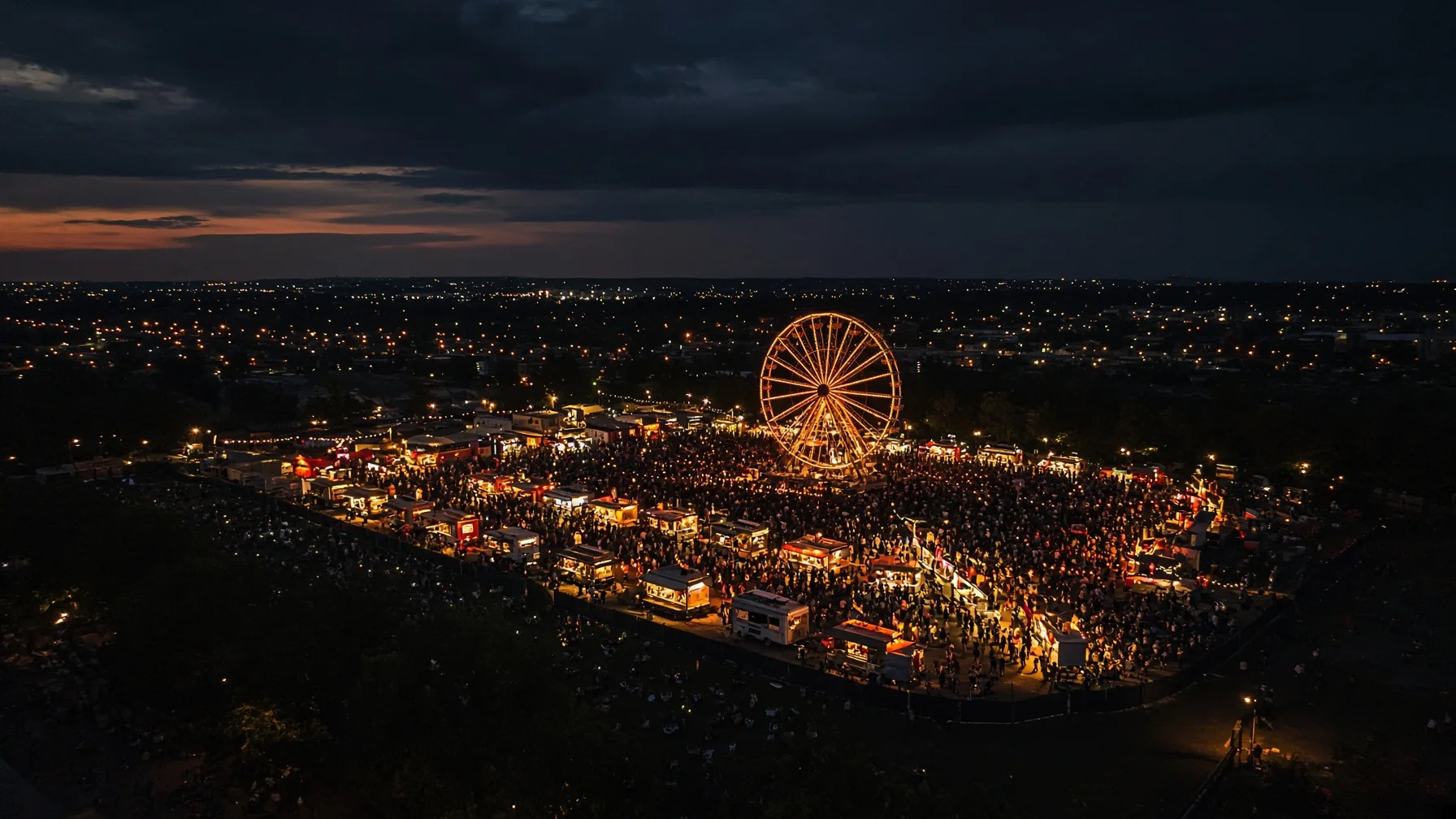
Community festivals, parades, fairs, road races, car shows, concerts, and holiday events are some of the most tempting drone subjects in Alabama. They also create the exact conditions that require the most planning: dense crowds, temporary road closures, moving vehicles, nearby airports, changing security plans, and limited emergency access.
The first question should not be, “Where can I launch?” It should be, “Can this flight be designed so the aircraft never creates an unacceptable risk to people on the ground?”
For most public events, the safest and most useful footage comes from the perimeter, before the crowd arrives, or from a controlled area coordinated with the organizer. Flying directly over a packed street is usually the wrong starting point.
Start by deciding whether the flight is recreational or commercial
The purpose of the flight matters.
A person flying strictly for personal enjoyment may operate under the federal recreational exception, but must follow all recreational requirements, including passing the TRUST safety test, registering when required, following an FAA-recognized community-based organization’s safety guidelines, keeping the drone within visual line of sight, and checking airspace before flying.
If the footage supports a business, client, sponsor, nonprofit promotion, paid social account, event organizer, real-estate company, tourism campaign, news assignment, vendor, or other non-recreational purpose, the operation generally belongs under Part 107. Payment is not the only factor. The FAA looks at the purpose of the flight.
For event organizers, the cleanest approach is to ask the pilot directly whether the mission will be conducted under Part 107 and to request the pilot’s certificate information, aircraft registration, and insurance documentation before event day.
A public event does not create permission to use the airspace
An organizer can grant access to private property, designate a launch area, and coordinate with security. That permission does not replace FAA authorization.
The pilot must still check the airspace at the exact location and time. Many Alabama communities are near airports, hospital heliports, military facilities, or controlled airspace. The FAA’s approved B4UFLY service providers can help identify controlled airspace and other advisories. When authorization is required, a Part 107 pilot may be able to request it through LAANC where available.
A city permit, festival credential, media badge, or property-owner approval is not an airspace authorization. The reverse is also true: FAA authorization does not automatically give a pilot permission to stand on private land, enter a secured event area, or interfere with local traffic control.
Operations over people are the central challenge
FAA rules allow certain operations over people only when the aircraft and operation meet specific requirements. The categories depend on factors such as aircraft weight, injury risk, exposed rotating parts, declarations of compliance, and whether the operation involves a sustained flight over an open-air assembly.
That means a pilot cannot assume that a small drone is automatically legal over a crowd.
A practical event plan should avoid sustained flight over spectators unless the pilot has confirmed that the aircraft and operation qualify under the applicable FAA category. Even when a flight may technically fit a category, the safer choice may still be to remain outside the crowd footprint.
Useful alternatives include:
- filming the venue before gates open;
- flying along the exterior edge of the event;
- using a controlled launch and recovery zone;
- capturing wide establishing shots from a distance;
- filming floats, booths, stages, or vehicles while the area beneath the aircraft is restricted;
- scheduling brief aerial windows during setup or teardown.
These approaches often produce cleaner footage because the pilot is not reacting to people unexpectedly moving beneath the aircraft.
Moving vehicles add another layer
Parades, car cruises, motorcycle rides, road races, and processions may include moving vehicles. FAA rules distinguish between transient crossings and sustained operations over moving vehicles, and the operation must fit the applicable category and conditions.
A closed road is not automatically an empty or controlled road. It may still contain floats, police vehicles, golf carts, motorcycles, runners, volunteers, and emergency traffic.
A safer plan is to position the aircraft beside the route and capture diagonal or lateral views rather than tracking directly above the moving procession. This can preserve the sense of motion without placing the drone over participants or vehicles for an extended period.
Check for temporary flight restrictions and event-specific security limits
Temporary Flight Restrictions can appear for security, emergency response, wildfire activity, major sporting events, or other reasons. A TFR may become active after an event plan has already been approved.
Pilots should check current FAA notices during planning and again shortly before launch. A weather delay, VIP visit, emergency, or nearby incident can change the operational picture quickly.
The event organizer should also identify the person who has authority to stop the flight. If law enforcement, fire personnel, emergency management, or the event director needs the drone grounded, the pilot should have a direct communication channel and a clear landing plan.
Remote ID and registration still apply
Most drones that are required to be registered must comply with Remote ID requirements unless operated within an FAA-Recognized Identification Area or another specific exception applies.
Event organizers should not treat Remote ID as a substitute for coordinating the operation. It is a federal identification requirement, not a crowd-management plan. The organizer still needs to know where the pilot will stand, where the aircraft will launch and land, what area will remain clear, and who will communicate with the pilot.
The registration number should be properly displayed on the aircraft, and the pilot should carry required documentation.
Build a real event flight plan
A useful plan should be short enough for the event team to follow but specific enough to prevent improvisation.
At minimum, document:
1. The exact flight area
Mark the launch point, landing point, crowd boundary, parade route, stage, vendor areas, power lines, light poles, trees, temporary cables, flags, cranes, tents, and emergency lanes.
2. The timing
Separate setup, public hours, headline activity, and teardown. The best aerial window may be twenty minutes before opening rather than during the busiest hour.
3. The people responsible
Name the remote pilot in command, visual observer if used, event contact, security contact, and emergency contact.
4. The stop conditions
Define wind limits, visibility concerns, rain policy, lost-link response, crowd encroachment, unauthorized aircraft, helicopter activity, and emergency-response triggers.
5. The shot list
Prioritize shots that can be captured without flying over spectators. A practical list might include the venue exterior, entrance signage, parade staging area, a wide crowd scene from outside the perimeter, vendor rows, a controlled vehicle pass, and a closing aerial after attendees leave.
Watch for helicopter and emergency activity
Medical helicopters, law-enforcement aircraft, news helicopters, and emergency-response flights can appear with little warning. The drone must always yield to crewed aircraft.
At large events, the pilot should avoid becoming so focused on the camera view that surrounding air traffic is missed. A visual observer can help scan the sky, watch the crowd boundary, and alert the pilot to changing conditions, but the remote pilot remains responsible for the operation.
If a helicopter is approaching or operating nearby, land promptly and reassess.
Coordinate with the organizer before advertising drone coverage
An event should not promise aerial footage before confirming that the mission is workable.
The organizer should provide the pilot with:
- the site map and event schedule;
- expected attendance pattern, without inflating or guessing crowd figures;
- road-closure and parade-route information;
- stage, fireworks, crane, balloon, or tethered-object plans;
- emergency-access routes;
- private-property permissions;
- security and law-enforcement contacts;
- any local permit or vendor requirements.
The pilot should provide the organizer with a flight concept, certificate and registration details, proof of insurance when requested, and a clear explanation of what footage may not be possible.
Do not use a drone to force a shot
A strong event video does not require hovering over the center of the crowd.
Ground cameras, elevated fixed cameras, long lenses, handheld gimbals, and pre-event drone footage can be combined into a better final product than one risky aerial pass. The drone should handle the wide perspective. Ground equipment should handle faces, performances, interviews, and close action.
This division of work also reduces noise and distraction during ceremonies, speeches, memorial events, worship services, and performances.
A simple go/no-go checklist
Before launch, confirm:
- the flight purpose and operating rules are clear;
- the pilot has the required certificate or TRUST documentation;
- the aircraft is registered and Remote ID compliant when required;
- current airspace and TFR information has been checked;
- property access and organizer permission are confirmed;
- the planned route avoids unauthorized sustained flight over people and moving vehicles;
- a controlled launch and landing area is maintained;
- weather and visibility are acceptable;
- crewed aircraft can be detected and avoided;
- the organizer and pilot share a stop-flight procedure.
When any of those pieces is missing, the correct answer may be to delay, redesign, or cancel the aerial portion.
Frequently Asked Questions
Can I fly over a parade if the street is closed?
A road closure does not automatically make an overhead flight legal or safe. Spectators, participants, floats, police vehicles, and support traffic may still be present. The operation must comply with FAA rules for people and moving vehicles, plus airspace requirements.
Does the festival organizer’s permission make the flight legal?
No. Organizer permission can address property access and event coordination, but it does not replace FAA airspace authorization or federal operating rules.
Can a recreational pilot film an event for the organizer for free?
The purpose of the flight matters more than whether money changes hands. If the flight benefits the organizer, a business, a promotional campaign, or another non-recreational purpose, Part 107 may apply.
Is a small drone allowed over a crowd?
Not automatically. The aircraft and operation must qualify under the FAA’s operations-over-people rules. Sustained flight over an open-air assembly has additional limits.
What is the safest time to capture aerial event footage?
Setup, staging, controlled demonstration windows, and teardown are often safer than peak attendance. The correct timing depends on airspace, weather, crowd movement, and the organizer’s control of the area.
SOURCE NOTES
- FAA — Recreational Flyers and Community-Based Organizations: https://www.faa.gov/uas/recreational_flyers
- FAA — Operations Over People General Overview: https://www.faa.gov/uas/commercial_operators/operations_over_people
- FAA — Remote Identification of Drones: https://www.faa.gov/uas/getting_started/remote_id
- FAA — B4UFLY Services: https://www.faa.gov/uas/getting_started/b4ufly
- FAA — Part 107 Waivers: https://www.faa.gov/uas/commercial_operators/part_107_waivers
- FAA — Temporary Flight Restrictions: https://www.faa.gov/uas/getting_started/where_can_i_fly/airspace_restrictions/tfr
- Electronic Code of Federal Regulations — 14 CFR Part 107: https://www.ecfr.gov/current/title-14/chapter-I/subchapter-F/part-107