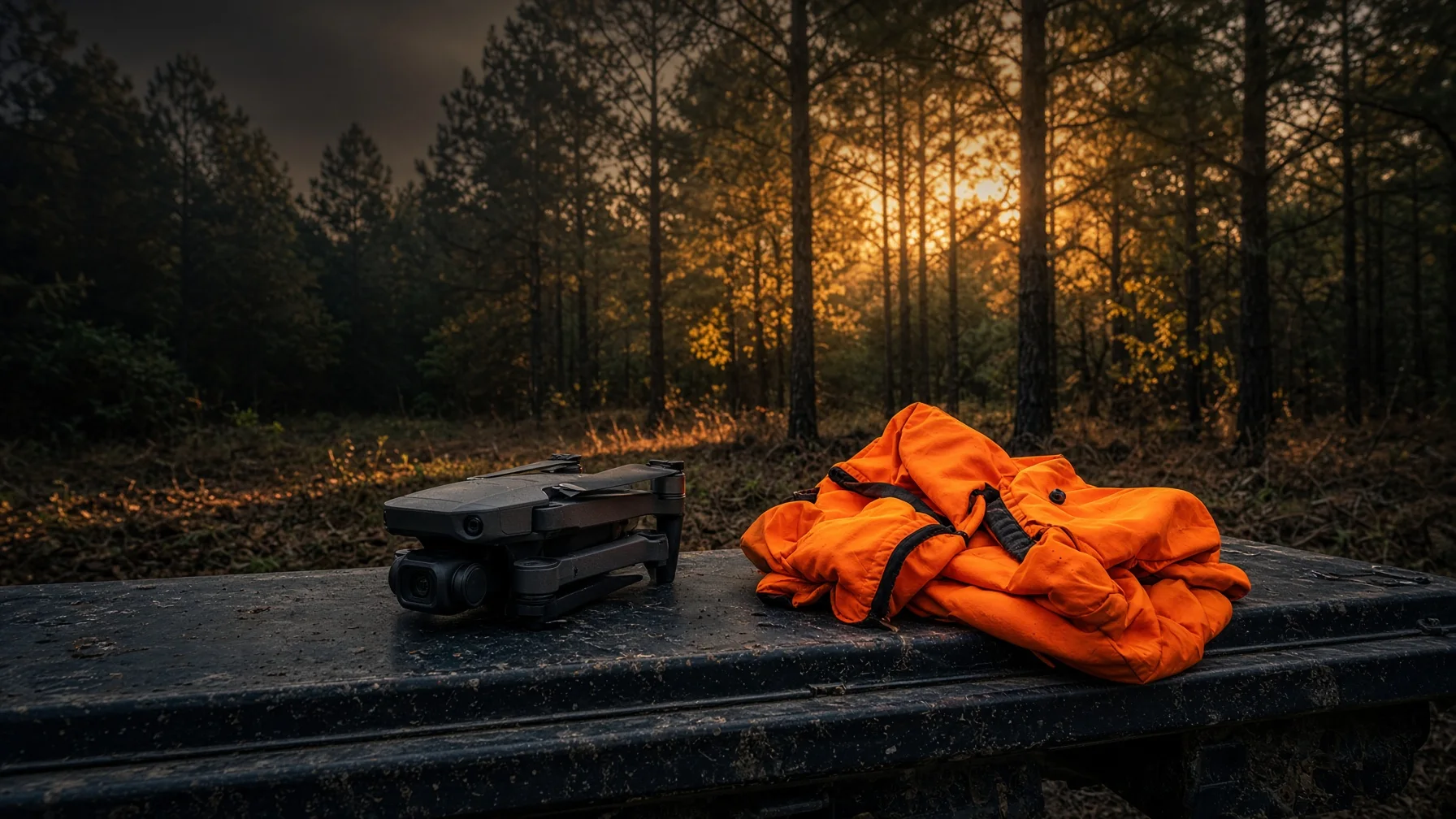
A drone may look like the perfect tool for checking a field edge, finding a difficult access route or getting a better view of hunting property. In Alabama, though, the legal answer depends on where you are flying, why you are flying and whether the drone is being used to help locate, pursue or take wildlife.
The safest practical rule is simple: do not use a drone as an aid to hunting, and do not assume public hunting land allows drone launch, landing, possession or operation. On many Alabama Wildlife Management Areas and certain state-managed lands, written permission is required before a drone can even be brought into use.
This is a field guide, not legal advice. Regulations and area permits can change, so check the current Alabama Department of Conservation and Natural Resources rules, the permit for the specific property and FAA airspace information before every flight.
The Difference Between Flying Near Hunting Land and Using a Drone to Hunt
Alabama Rule 220-2-.11 prohibits hunting, taking, capturing or killing wildlife from or with the aid of an aircraft or other mechanically propelled device. A drone is an aircraft. That makes using one to locate game, drive wildlife, direct hunters or otherwise improve the chance of a take legally risky and potentially prohibited.
The important distinction is purpose. A separate recreational flight over private property to photograph fall color is not automatically the same as using a drone to help a hunt. But the closer the flight is connected to locating animals, tracking their movement, guiding a hunter or recovering information for an active hunt, the harder it is to claim the drone was unrelated.
Avoid gray areas. Do not fly ahead of hunters to scout animals in real time. Do not relay wildlife locations to someone in the field. Do not use the drone to push deer, turkey, waterfowl or other animals toward a hunter. Do not circle low over wildlife or repeatedly approach it for footage.
Alabama WMAs Have a Direct Drone Restriction
Alabama Administrative Code Rule 220-2-.55 governs Wildlife Management Areas. The rule states that an unauthorized person may not launch, land, possess or use a UAV or drone on an AREA without written permission from the Wildlife and Freshwater Fisheries Division.
That wording is broader than simply banning flight during a hunt. It covers launching, landing, possession and use on the managed area. A pilot should not assume that standing on a WMA road, parking area or trailhead is acceptable just because the drone will quickly fly elsewhere.
Before bringing a drone to a WMA:
- Read the current WMA permit and map.
- Confirm whether the property is inside the regulated AREA boundary.
- Contact the Wildlife and Freshwater Fisheries Division if written permission may be available.
- Keep the permission with you if it is granted.
- Check for any seasonal closure, hunt, prescribed burn or temporary safety restriction.
A general FAA authorization does not override a land manager's rules. FAA airspace approval answers whether the aircraft may operate in that airspace; it does not give permission to launch from property where drone use is prohibited.
Forever Wild and State Lands Can Have Similar Restrictions
Alabama rules for certain Forever Wild and State Lands Division properties also restrict unauthorized drone activity. Rule 220-2-.125 includes provisions making it illegal for an unauthorized person to launch, land, possess or use a drone without written permission from the Alabama State Lands Division on covered properties.
Rule 220-4-.15 contains a similar restriction for certain state-owned lands and submerged lands managed under that chapter. The exact property category matters, so do not rely on a generic “public land” answer.
For any Alabama outdoor destination, identify the actual land manager. A location may be a state park, WMA, Forever Wild tract, national forest, municipal park, lake authority property, private timberland or a patchwork of several jurisdictions. Each can have different launch and access rules even when the airspace looks open in a flight app.
Private Property Is Not a Free Pass
Private property can remove some public-land access issues, but it does not remove hunting laws or FAA requirements. The landowner's permission is important for takeoff, landing and access. It does not authorize the use of an aircraft to aid an unlawful hunting method.
On private hunting land, keep drone work clearly separate from active hunting. Reasonable low-risk uses may include documenting roads after a storm, photographing a cabin, mapping erosion or recording a property boundary for general land-management purposes. Even then, avoid disturbing wildlife and do not use the resulting live information to direct a hunt.
If a flight is being performed for a client, land-management company, outfitter, real estate purpose or other non-recreational reason, it will generally fall under FAA Part 107 rather than the recreational exception. The FAA explains that compensation is not the only test; the purpose of the flight determines which operating rules apply.
Wildlife Disturbance Is a Real Safety and Ethics Issue
Even where a launch is otherwise allowed, chasing wildlife with a drone is a bad plan. Animals can be stressed, displaced from cover or pushed toward roads, fences, people or other hazards. Nesting birds and young animals are especially vulnerable to repeated close approaches.
Use a long lens and conservative distance. If an animal changes direction, repeatedly looks at the drone, runs, leaves a nest area or shows agitation, back away. Never descend for a close-up simply because the camera makes the scene look farther away.
The Alabama regulations also protect many nongame species. A pilot should not treat wildlife filming as harmless merely because no weapon is involved. Harassment, disturbance and interference can create legal and ethical problems depending on the species, location and conduct.
FAA Rules Still Apply in the Woods
Remote locations are not outside the National Airspace System. Recreational pilots must follow the FAA's recreational flyer requirements, including:
- Fly only for recreational purposes under the recreational exception.
- Pass TRUST and carry proof of completion.
- Keep the drone within visual line of sight or use a co-located visual observer.
- Give way to all crewed aircraft.
- Stay at or below 400 feet in Class G airspace.
- Obtain prior FAA authorization before flying in controlled airspace.
- Register drones that weigh 250 grams or more, unless a specific exception applies.
- Comply with Remote ID when the drone is required to be registered or has been registered.
Hunting areas may also have low-flying helicopters, crop dusters, firefighting aircraft, law-enforcement aircraft or military traffic. Trees and terrain make aircraft harder to see and hear. Keep the drone close, maintain a clear escape route and land immediately when crewed aircraft approach.
Check Airspace, TFRs and Local Conditions Before Launch
Use an FAA-approved B4UFLY service or another authoritative airspace source before every flight. Controlled airspace may require LAANC authorization. Temporary Flight Restrictions can appear for emergencies, VIP movement, wildfire response or major events.
Wildfire smoke deserves special attention. A drone near firefighting aircraft can halt aerial suppression operations. If emergency aircraft are working anywhere nearby, do not launch. If they appear after takeoff, land immediately.
Also consider practical hunting-season hazards: limited visibility at dawn and dusk, hunters wearing camouflage, vehicles on narrow roads and dogs working through cover. Pick a launch point away from active hunters and never fly where the drone could distract someone handling a firearm.
A Practical Preflight Checklist for Alabama Hunting Country
Before launching, answer these questions:
- Who manages the land under my feet?
- Does the property prohibit possession, launch, landing or use of a drone?
- Do I have written land-manager permission when required?
- Is the flight completely separate from locating, pursuing or taking wildlife?
- Is the purpose recreational, or does it require a Part 107 remote pilot?
- Have I checked controlled airspace, TFRs and local restrictions?
- Is the drone properly registered and Remote ID compliant?
- Have I passed TRUST if flying recreationally?
- Can I maintain visual line of sight around trees and terrain?
- Are hunters, wildlife or low-flying aircraft likely to be affected?
If any answer is unclear, postpone the flight and verify it first.
The Bottom Line
A drone can be used for outdoor photography and property documentation in Alabama, but it should not be used to aid a hunt. On Alabama WMAs and certain Forever Wild or State Lands Division properties, unauthorized launch, landing, possession or use may be prohibited without written permission.
Treat FAA compliance and land-manager permission as two separate checks. Then add a third: make sure the flight is not being used to locate, drive, pursue or otherwise assist in taking wildlife. That three-part check keeps the mission safer, more defensible and less likely to interfere with hunters or animals.
Frequently Asked Questions
Can I use a drone to scout deer before a hunt in Alabama?
Using an aircraft to aid hunting can violate Alabama's prohibited-method rules. Real-time scouting, locating animals for hunters or using drone information to direct an active hunt should be avoided.
Can I launch a drone from an Alabama WMA?
Not without authorization. Rule 220-2-.55 says an unauthorized person may not launch, land, possess or use a UAV or drone on an AREA without written permission from the Wildlife and Freshwater Fisheries Division.
Can I fly over a WMA if I launch from private property?
Airspace and land-use questions are separate, and overflight can involve additional legal and safety issues. Do not assume an off-site launch makes the mission acceptable. Check current WMA rules, FAA airspace requirements and the exact purpose of the flight.
Do I need Part 107 to photograph hunting property?
A purely recreational flight may qualify for the recreational exception. A flight performed for a client, business, outfitter, land-management purpose or other non-recreational objective generally requires compliance with Part 107.
Does a sub-250-gram drone avoid all the rules?
No. A light recreational drone may be exempt from FAA registration in some circumstances, but airspace, visual-line-of-sight, land-manager, wildlife and hunting-method rules still apply. If the drone is registered, Remote ID requirements may also apply.
SOURCE NOTES
Alabama Administrative Code Rule 220-2-.11, Prohibited Methods and Devices for Hunting:
https://admincode.legislature.state.al.us/administrative-code/220-2-.11Alabama Administrative Code Rule 220-2-.55, Wildlife Management Areas of Alabama:
https://admincode.legislature.state.al.us/administrative-code/220-2-.55Alabama Administrative Code Rule 220-2-.125, Special Hunting Seasons for Certain Forever Wild and State Lands Division Lands:
https://admincode.legislature.state.al.us/administrative-code/220-2-.125Alabama Administrative Code Rule 220-4-.15, State Lands restrictions:
https://admincode.legislature.state.al.us/administrative-code/220-4-.15FAA Recreational Flyers and Community-Based Organizations:
https://www.faa.gov/uas/recreational_flyersFAA How to Register Your Drone:
https://www.faa.gov/uas/getting_started/register_droneFAA Remote Identification of Drones:
https://www.faa.gov/uas/getting_started/remote_idFAA Airspace Authorizations for Recreational Flyers:
https://www.faa.gov/uas/recreational_flyers/authorization