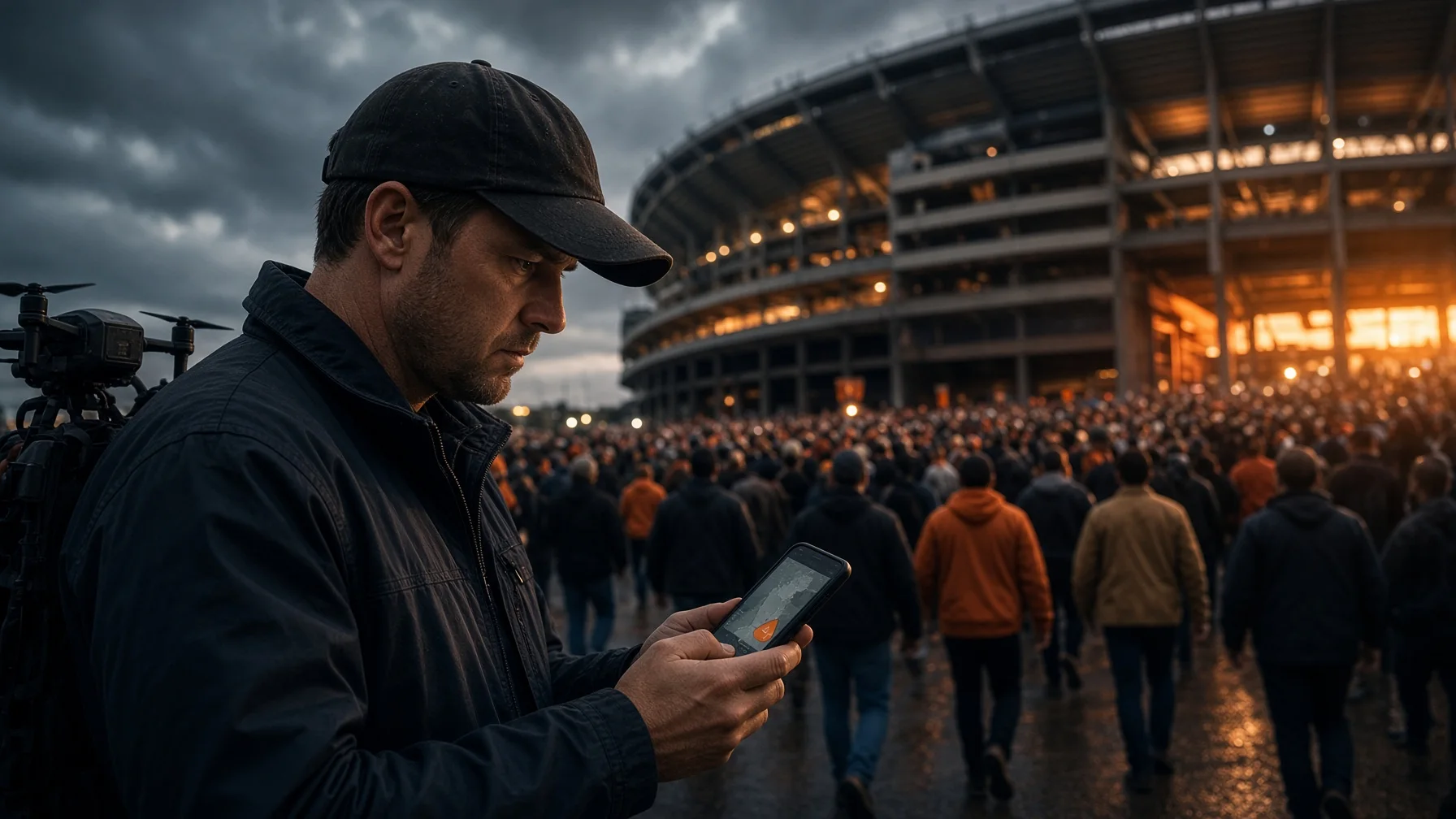
On a normal weekday, a location a few miles from Bryant-Denny Stadium or Jordan-Hare Stadium may look flyable in an airspace app. On a college-football Saturday, the same location can fall inside a federal temporary flight restriction that applies to drones.
That catches people because the restriction is based on the event, not on a permanent red circle around the stadium. It switches on before the game, stays active through the event, and continues afterward. A pilot who checked the area earlier in the week can still be grounded on game day.
The basic rule is simple: FAA rules prohibit drone operations within three nautical miles of a qualifying stadium during an NCAA Division I football game, beginning one hour before the scheduled event and ending one hour after it finishes. The details matter, especially when kickoff times change, weather delays the game, overtime extends it, or the requested flight is near—but not directly over—the stadium.
The restriction covers much more than the stadium property
Three nautical miles is approximately 3.45 statute miles. That means the restricted area extends well beyond the stands, parking lots, and university-owned property.
In Tuscaloosa, a three-nautical-mile circle around Bryant-Denny can affect downtown properties, nearby neighborhoods, construction sites, commercial buildings, and real-estate jobs that have nothing to do with the football game. The same is true around Jordan-Hare in Auburn.
The purpose of your flight does not create an exception. A roof inspection, home-listing shoot, construction-progress visit, social-media clip, or tailgate video can still be prohibited when the coordinates and time fall inside the active TFR.
Property permission also does not override the restriction. A homeowner, business owner, Realtor, venue, or event sponsor may control access to the ground, but federal airspace restrictions remain separate.
When does the stadium TFR start and stop?
The FAA states that the sporting-event restriction begins one hour before the scheduled start and ends one hour after the event concludes.
The scheduled kickoff is therefore only the starting point for planning. The real end time may move because of:
- Overtime
- Weather delays
- A postponed or suspended game
- Broadcast or event pauses
- A schedule update
The FAA’s Sporting Event Automated Monitoring System, or SEAMS, is designed to provide current event dates, locations, active times, and map information. The FAA says the system receives schedule updates from the covered leagues and organizations, including changes caused by delays, overtime, pauses, and cancellations.
Do not calculate the end time by adding a fixed number of hours to kickoff. Check the current event status and the applicable restriction close to flight time.
Which Alabama games trigger the standard stadium restriction?
The FAA’s standard stadium rule includes NCAA Division I football. That makes University of Alabama and Auburn home football games obvious local examples.
Alabama’s published 2026 home schedule in Tuscaloosa includes East Carolina on September 5, Florida State on September 19, South Carolina on September 26, Georgia on October 10, Texas A&M on October 24, Chattanooga on November 21, and Auburn on November 28.
Auburn’s official 2026 schedule lists home games at Jordan-Hare against Southern Miss on September 12, Florida on September 19, Vanderbilt on September 26, LSU on October 24, Arkansas on November 7, and Samford on November 21.
Schedules and kickoff times can change. Some games are published only with broad television windows until networks assign an exact time. Use the official team schedule for planning, then confirm the live event and airspace information before launch.
Do not assume every sporting event uses this same automatic rule. The FAA page specifically lists Major League Baseball, NFL, NCAA Division I football, NASCAR Cup, IndyCar, and Champ Series events. Other games, concerts, festivals, races, or large gatherings may have a separate TFR, another airspace restriction, local launch rules, or no event-specific federal TFR at all. Check the actual location and date rather than applying the football rule to every crowd.
LAANC approval does not cancel a stadium TFR
This is one of the most important game-day distinctions.
LAANC is a system for obtaining authorization to operate in controlled airspace near participating airports. A stadium TFR is a separate temporary restriction. Receiving a LAANC authorization does not erase or override an active TFR.
A pilot may therefore have:
- LAANC authorization for the requested altitude, but no authority to enter the active stadium TFR
- A location outside controlled airspace, but still inside the stadium TFR
- A location outside the stadium TFR, but still subject to controlled-airspace authorization or another restriction
Treat each layer separately. Check controlled airspace, TFRs and NOTAMs, special-security restrictions, property access, and the operating rules that apply to the flight.
A green status indicator in one app is not permission to ignore an active restriction. Read the current information for the exact coordinates and time.
Can you launch outside the circle and fly toward the stadium?
No. The restriction applies to operating the drone within the protected airspace, not merely to where the pilot stands or where the aircraft takes off.
Launching from private property outside the stadium grounds does not make it legal to fly into the restricted circle. The same applies to launching outside a campus boundary, from a parking area, from a rooftop, or from a nearby neighborhood.
The planned flight path must remain outside the restricted airspace unless the operation has specific authorization that applies to that TFR.
What about a tiny drone under 250 grams?
The weight-based registration exception for some purely recreational drones does not create an exception to a TFR.
The FAA says recreational drones under 250 grams generally do not require registration when flown only under the recreational exception. That does not mean they can fly inside prohibited or restricted airspace. Stadium TFR rules apply to drone operations regardless of whether the aircraft is a lightweight camera drone or a larger registered aircraft.
Small drones can still create a safety and security concern near a stadium, crowd, helicopter route, law-enforcement operation, or emergency response.
A practical game-day planning process
A responsible plan starts before loading the drone into the truck.
1. Get exact coordinates
Do not accept “near campus,” “downtown Tuscaloosa,” or “a couple miles from the stadium” as a usable location. Get the exact address, launch point, work area, maximum altitude, and expected flight path.
2. Check the official game schedule
Confirm whether Alabama, Auburn, or another qualifying Division I program has a home game. Note the scheduled kickoff and whether the time is exact or still listed as a television window.
3. Check SEAMS, B4UFLY, and current FAA TFR information
Use the FAA’s current sporting-event and TFR resources. B4UFLY-approved providers can show temporary restrictions and other airspace information, but the pilot remains responsible for understanding the actual restriction.
4. Check controlled airspace separately
Determine whether LAANC or another FAA authorization is required for the location. Do not confuse that authorization with TFR access.
5. Build in schedule uncertainty
Do not schedule a flight for an estimated one hour after a game should end. Overtime, weather, or delays can keep the restriction active longer. Verify the current end time before launch.
6. Decide whether to proceed, relocate, reschedule, or decline
A legal alternative may be available:
- Fly early in the morning before the TFR begins, if all other rules permit
- Return the following day
- Move the flight to a location outside the restricted radius
- Capture ground-based images instead
- Use existing lawful imagery
- Redesign the shot so the aircraft never enters the restricted area
The client should understand that a game-day airspace restriction is not a weather cancellation or a pilot preference. It is an operating limitation.
7. Save the record
Keep the address and coordinates, official event schedule, TFR or SEAMS check, controlled-airspace authorization, property permission, date and time, and final go-or-no-go decision. Screenshots are more useful when they show the location and timestamp rather than an unlabeled map alone.
Tailgates, crowds, roads, and campus rules still matter outside the TFR
Being outside the three-nautical-mile circle does not automatically make a flight safe or legal.
Game day can bring dense crowds, moving vehicles, temporary structures, emergency aircraft, security perimeters, and rapidly changing access conditions. Part 107 rules concerning operations over people and moving vehicles may apply to commercial work. Recreational pilots must also operate safely and follow the FAA’s recreational requirements.
The FAA requires recreational flyers to take the TRUST test and carry proof of passage. Drones that require registration generally must also comply with Remote ID unless operated within an approved exception such as a FRIA. Commercial pilots need a current Remote Pilot Certificate and must follow Part 107 and any applicable authorization or waiver.
Campus, city, venue, or property rules may restrict where you can stand, launch, land, park, or enter. Those ground rules are separate from FAA airspace authority.
Do not rely on a client saying the flight is “approved”
Event organizers, media buyers, athletic departments, sponsors, and property owners may have legitimate reasons to request aerial work. That does not mean a general email, media credential, sideline pass, or verbal approval authorizes flight inside a federal TFR.
For any claimed authorized operation, obtain written details identifying:
- The organization requesting the flight
- The exact location, altitude, route, and time
- The remote pilot in command
- The federal authorization that applies to the restriction
- The conditions and operating limitations
- The security or law-enforcement contact
- The procedure if the event time or restriction changes
Do not improvise inside restricted airspace based on a client’s assumption.
The simple Alabama rule
On Alabama football Saturdays, think beyond the stadium fence.
A qualifying game can create a three-nautical-mile federal drone restriction from one hour before the scheduled start until one hour after the event ends. Check the live event information, do not treat LAANC as TFR permission, and do not guess when the restriction has expired.
The professional move is often to reschedule, relocate, or provide a lawful alternative. Missing one sunset shot is cheaper than entering restricted airspace without authority.
Frequently Asked Questions
Can I fly a drone over a tailgate outside the stadium?
Possibly, but only if the location is outside any active TFR and the flight complies with all other rules. Many tailgate areas near Bryant-Denny and Jordan-Hare can fall inside the three-nautical-mile restriction. Crowds, moving vehicles, property rules, and controlled airspace may create additional limits.
Does the stadium TFR apply during away games?
The standard sporting-event restriction is centered on the venue hosting the qualifying event. An Alabama or Auburn away game does not create that football TFR around the empty home stadium solely because the team is playing elsewhere. Another event or separate restriction could still affect the area.
Can I fly two hours after kickoff if the game is still being played?
No. The restriction remains active through the event and for one hour after it ends. A long game, overtime, or weather delay can push the expiration later.
Is a Part 107 certificate enough to fly inside the TFR?
No. A Remote Pilot Certificate does not itself authorize entry into an active stadium TFR. The operation must meet the authorization terms applicable to that restriction.
Where should I check before flying?
Check the official event schedule, the FAA’s Stadiums and Sporting Events page and SEAMS information, current TFRs and NOTAMs, and an FAA-approved B4UFLY or LAANC provider as applicable. Confirm the exact coordinates and current time before launch.
Source Notes
Federal Aviation Administration — Stadiums and Sporting Events
https://www.faa.gov/uas/getting_started/where_can_i_fly/airspace_restrictions/sports_stadiums
Federal Aviation Administration — Temporary Flight Restrictions
https://www.faa.gov/uas/getting_started/temporary_flight_restrictions
Federal Aviation Administration — B4UFLY
https://www.faa.gov/uas/getting_started/b4ufly
Federal Aviation Administration — Recreational Flyers and Community-Based Organizations
https://www.faa.gov/uas/recreational_flyers
Federal Aviation Administration — Remote Identification of Drones
https://www.faa.gov/uas/getting_started/remote_id
Federal Aviation Administration — How to Register Your Drone
https://www.faa.gov/uas/getting_started/register_drone
University of Alabama Athletics — 2026 Football Schedule
https://rolltide.com/sports/football/schedule
Auburn University Athletics — 2026 Football Schedule
https://auburntigers.com/sports/football/schedule/season/2026